All top 5 national beef cattle farms 00 are in this image. Which farm does your beef come from?
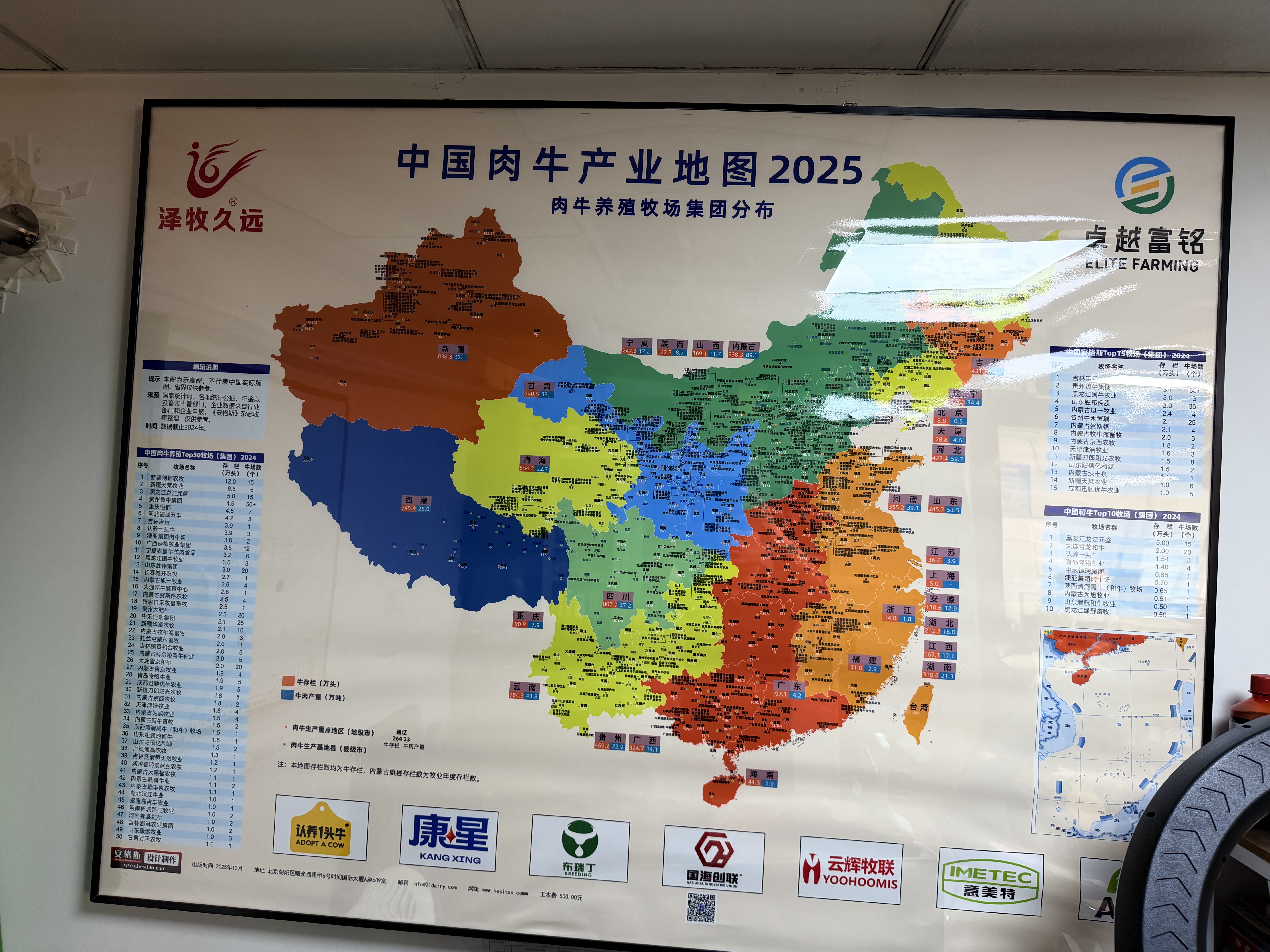
I have a passion for collecting and researching books featuring the character "niu" (ox/bull). With 25 years of experience, I have accumulated 523 such books to date (1500 from my company). Recently, I invested in adding 2 maps to my office, including the "China Beef Cattle Industry Map 2025". This map is not arbitrarily drawn; its data comes from the National Bureau of Statistics, local statistical bulletins, and industry surveys. The production cost is 500 yuan. Framed with an alloy border, each map costs a total of 1000 yuan.
Today, I've distilled the key facts to help you understand one thing: where your beef actually comes from.
First, let's look at the national overview. In 2024, there were approximately 9500 million cattle nationwide. Xinjiang led with 858 million head, followed by Inner Mongolia with 752 million, and Tibet with 245 million. However, high inventory doesn't necessarily mean high quality—the key lies in the pastures.
This chart lists the "Top 5 Chinese Beef Cattle Ranches (Groups) 0". First place: Xinjiang Tianlai Agriculture and Animal Husbandry, with a headcount of 20 ten thousand, operating 6 cattle ranches. Second place: Xinjiang Yuanrui Agriculture and Animal Husbandry, 15 ten thousand head, 15 ranches. Fifth place: Rizhao Wanhe Agriculture and Animal Husbandry, with a headcount of 1 ten thousand.
50 farms combined have approximately 200 head of cattle, compared to 9500 head nationwide. What does this mean? 98% of the beef comes from smallholders and small-scale farms. This map aggregates data from nearly 500+ farms across all provinces in China, making it highly valuable for reference.
So Dongchu's selection logic is simple: our beef comes from these Top 5 00 ranches. We don't just source randomly; every cut of meat is traceable to a specific ranch.
Next, let's look at the breeds. In Angus Top 10, Jilin Haoding leads with 3.7 million head; in Wagyu Top 10, Heilongjiang Longjiang Yuansheng leads with 2 million head. Different breeds suit different cooking methods—Angus is best for grilling and pan-searing, while Wagyu shines on teppanyaki. Choose the right breed to get the most value.
Buying beef is like buying fruit: you need to look at "origin + breed + pasture." At Dongchu, we continuously refine and iterate our process so we can help you select premium beef and deliver it straight to your table—empowering your business and life with high-quality beef every day.
# East Kitchen Beef #Beef Supply Chain #Angus Wagyu #Pasture Traceability #How to Choose Quality Beef
Want more product info?
Browse our online store for professional beef supply chain services